Immune tolerance against commensal microbiota and dietary antigens is established during early life through the induction of RORgt+ Foxp3+ regulatory T (Treg) cells, referred to as periphery induced RORgt+ pTreg cells. Recently, a novel family of RORgt expressing antigen-presenting cells (APCs), including ILC3, eTAC/Janus cells, and Thetis cells (TCs), has been proposed to prime the differentiation of RORgt+ pTreg cells. Among these populations, accumulating evidence suggests that Thetis cell subset IV (TC IV) plays an essential role in establishing intestinal tolerance. However, the transcription factors governing the differentiation of this subset remain poorly understood.
Here we show that Runx/Cbfβ complexes regulate the development of specific TC subsets. Mice lacking Cbfβ2 exhibited a marked reduction of TC II, III and IV, accompanied by a loss of RORgt+ pTreg cells. Transgenic Cbfβ2 expression by Cd11c-Cre restored TC IV and RORgt+ pTreg cell differentiation in Cbfβ2-deficient mice.
Furthermore, conditional inactivation of Runx1 and Runx3 using Cd11c-Cre selectively impaired the development of TC III and IV. Conversely Cd11c-Cre-driven transgenic Runx expression enhanced TC IV differentiation, which is accompanied with rescue of antigen uptake capacity of cDCs and TC-IV. As a result, RORgt+ pTreg differentiation was not only restored but further enhanced.
Interestingly, we recently observed that the expanded RORgt+ pTreg population co-expresses the transcription factor HELIOS. We are currently investigating the mechanisms responsible for the induction of this HELIOS+ RORgt+ pTreg subset.
Collectively, these findings establish a critical role for the Runx/Cbfβ pathway in TC IV differentiation and provide new insights into therapeutic interventions aimed at promoting RORgt+ pTreg cell induction for the treatment of autoimmune and inflammatory diseases.
Referent:
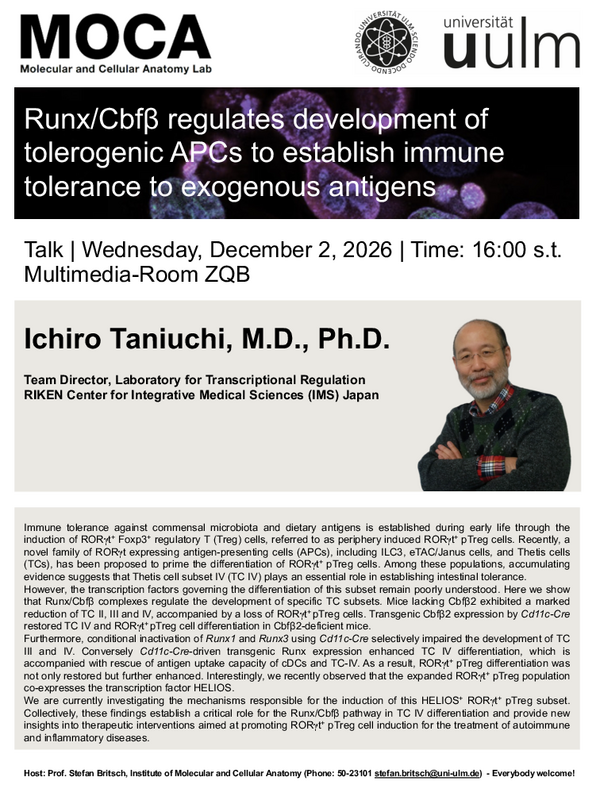
Ichiro Taniuchi, M.D., Ph.D.
Team Director, Laboratory for Transcriptional Regulation
RIKEN Center for Integrative Medical Sciences (IMS), Japan