Precision Therapeutics to Eliminate Viral Reservoirs
Viral infections, from the rapidly spreading acute respiratory viruses, like Influenza and severe-acute-respiratory-syndrome-related coronavirus 2 (SARS-CoV-2) to persistent viruses, such as the human immunodeficiency virus type 1 (HIV-1) and Hepatitis B and C, pose significant global health challenges. Viruses evade the immune system and infection might lead to long-term health issues and post-acute sequelae. Currently, no specific therapeutics are available against most viral pathogens and no antiviral therapy exists that specifically eliminates infected cells to cure chronic infections
Recently, we established VSV particles lacking their G-Glycoprotein (ΔG) but carrying Angiotensin-Converting Enzyme 2 (ACE2), the entry receptor of SARS-CoV-2, as a novel, highly specific class of antivirals. By reversing the usual glycoprotein–receptor interaction, these particles neutralise virions and selectively eliminate cells displaying the viral glycoprotein, in cell culture and in a Syrian hamster model. We now aim to broaden this approach to other high-risk and emerging enveloped viral pathogens, focusing on those for which no specific antiviral therapy is available or which establish long-term viral reservoirs.
Discovery of virus-specific and broad-spectrum entry inhibitors of viral pathogens
All enveloped viruses enter cells through membrane fusion mediated by their envelope glycoproteins (Env GPs), the first step at which infection can be blocked. We analyse this step with VSVΔG pseudoparticles, using a collected panel of Env GP constructs from more than 200 viral pathogens that covers all three classes of fusion proteins as well as diverse entry routes and receptors. Particles encoding different fluorescent reporters let us compare cell entry mediated by several Env GP proteins in a single infection setting, thereby separate virus-specific from broad-spectrum activities.
Pseudoparticle- and wild-type-virus-based screening of human-derived peptide libraries has already yielded inhibitors such as VIRIP, an α1-antitrypsin fragment blocking the HIV-1 gp41 fusion peptide, which we have shortened, stabilised and optimised into considerably more potent derivatives, endogenous inhibitors of the host proteases that activate respiratory viruses, and the atracurium breakdown product laudanosine, which restricts Ebola virus entry.
We now apply our pseudoparticle-based screening strategy to determine the entry-modulating ability of peptide and small-molecule libraries, purifying the active compounds, defining which entry step is affected and optimising the most promising candidates towards antiviral application.
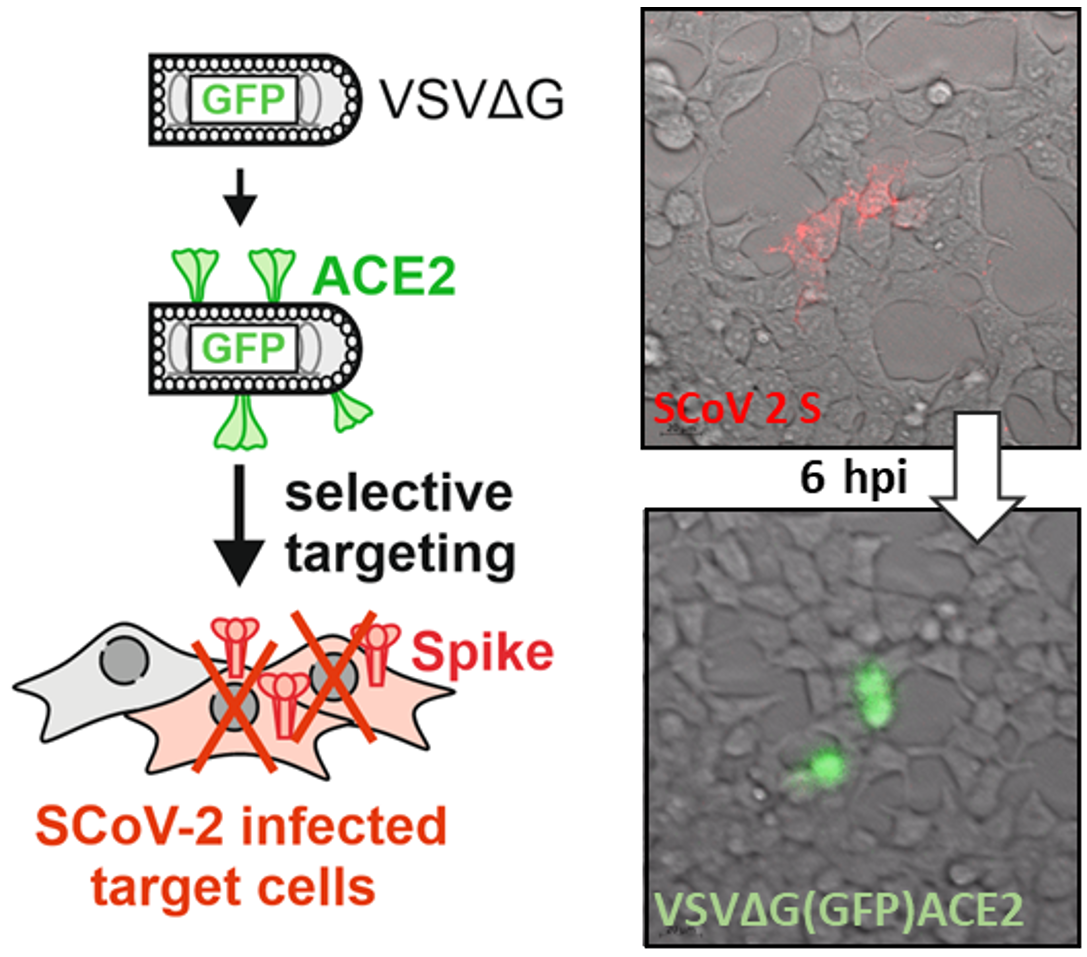
VSVΔG carring ACE2 specifically target cells expressing the SARS-CoV-2 Spike Protein.
Current Lab Members
Tom Seitz | PhD Student | 2025 - |