The retina is a highly organized tissue in which neurons, macroglia, microglia, and vascular cells continuously communicate to maintain function and homeostasis. When this communication breaks down, the consequences can be strikingly different depending on which cellular compartment is affected: photoreceptor degeneration on the one hand, or pathological blood vessel growth on the other. Both processes are central to blinding diseases such as retinitis pigmentosa, age-related macular degeneration (AMD), and diabetic retinopathy, yet they are often studied in isolation. In this talk, I will present work from our group illustrating how dissecting cell-type-specific signaling can reveal shared principles underlying both neurodegeneration and angiogenesis in the retina.
Using single-cell RNA sequencing together with cell-type-specific mouse genetics, we show that disrupting signaling in Müller glia and photoreceptors renders the retina considerably more vulnerable to light-induced degeneration, whereas restricting the same genetic manipulation to only one of these cell types is not sufficient—pointing to a cooperative, multicellular protective mechanism rather than a cell-autonomous one. In a second, complementary model, we turn to the vasculature and ask how endothelial cells and microglia interact during the development of choroidal neovascularization, the hallmark of neovascular AMD.
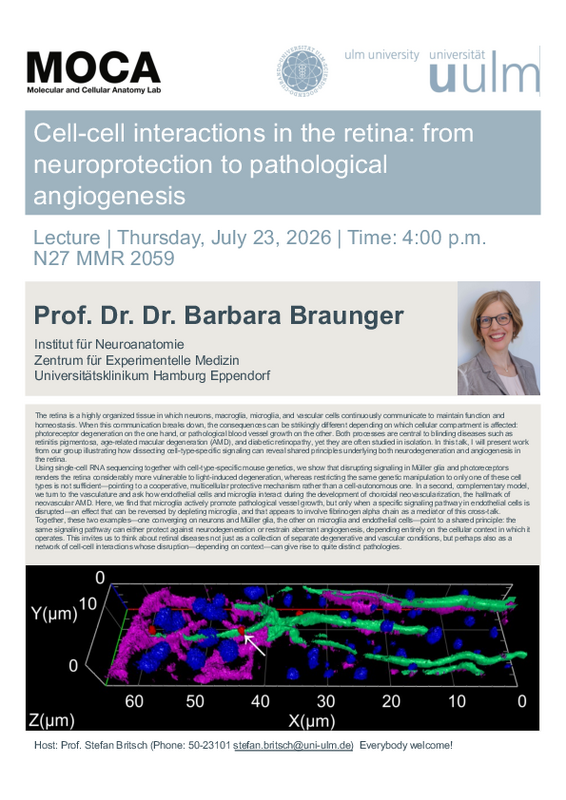
Here, we find that microglia actively promote pathological vessel growth, but only when a specific signaling pathway in endothelial cells is disrupted—an effect that can be reversed by depleting microglia, and that appears to involve fibrinogen alpha chain as a mediator of this cross-talk. Together, these two examples—one converging on neurons and Müller glia, the other on microglia and endothelial cells—point to a shared principle: the same signaling pathway can either protect against neurodegeneration or restrain aberrant angiogenesis, depending entirely on the cellular context in which it operates. This invites us to think about retinal diseases not just as a collection of separate degenerative and vascular conditions, but perhaps also as a network of cell-cell interactions whose disruption—depending on context—can give rise to quite distinct pathologies.