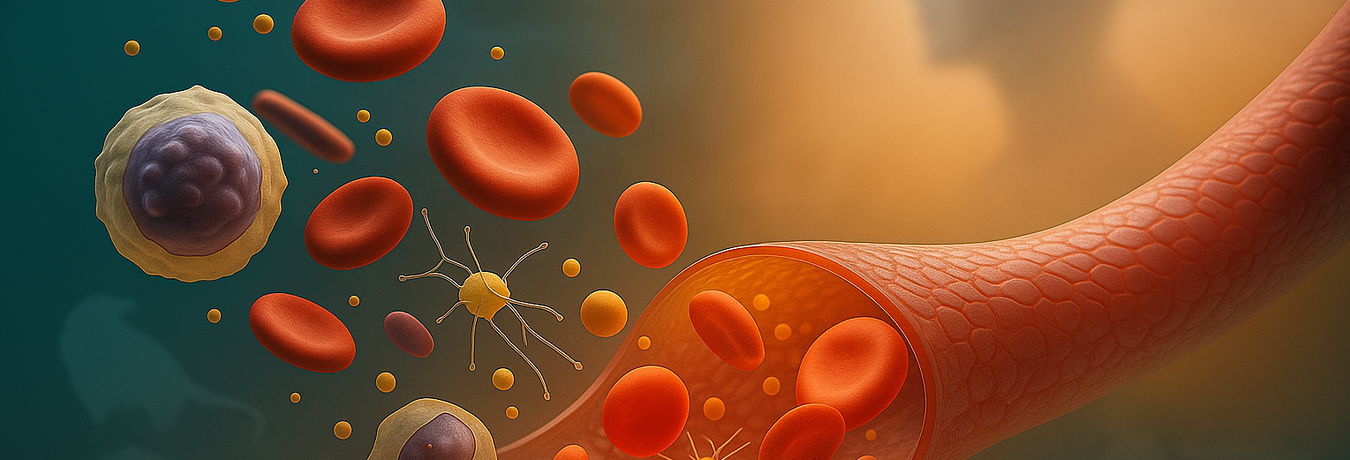
The Thromboinflammation Group investigates how inflammatory, vascular, and haemostatic pathways interact during acute tissue injury to shape microvascular function and organ outcome. Our work focuses on the mechanisms by which injury-induced inflammation and coagulation become mutually reinforcing, forming thromboinflammatory circuits that can either facilitate controlled repair or escalate into microvascular dysfunction and organ failure. By dissecting these coupled responses, we aim to establish mechanistic biomarkers and develop targeted interventions for trauma, haemorrhage, and transfusion-associated injury.
Acute injury triggers rapid and tightly coordinated activation of immune, endothelial, and coagulation systems. Rather than functioning as separate entities, these pathways form an integrated network that governs vascular integrity, intravascular inflammation, fibrin deposition, and tissue regeneration. To unravel this complexity, the Thromboinflammation Group combines advanced in vitro and ex vivo platforms with high-resolution analysis of inflammatory–haemostatic communication. Complementary in vivo studies provide essential physiological context to interrogate multi-organ interactions and evaluate therapeutic strategies. Our models span modular murine systems of tissue trauma, haemorrhage, and combined injuries (thoracic, hepatic, skeletal), as well as large-animal models that capture clinically relevant coagulopathy and enable translational testing.
Publications
- Rayatdoost F, Kapur R. Transfusion-related acute lung injury: experimental models to study pathogenesis and therapeutic strategies. Curr Opin Immunol. 2025 Oct;96:102650. doi: 10.1016/j.coi.2025.102650. Epub 2025 Aug 26. PMID: 40865410.
- Rayatdoost F, Deventer K, Rossaint R, Schöchl H, Grottke O. Comparative analysis of andexanet alfa and prothrombin complex concentrate in reversing anticoagulation by rivaroxaban ex vivo. Br J Anaesth. 2024 Feb;132(2):251-259. doi: 10.1016/j.bja.2023.10.018. Epub 2023 Nov 28. PMID: 38030550.
- Rayatdoost F, Grottke O. The Use of Large Animal Models in Trauma and Bleeding Studies. Hamostaseologie. 2023 Oct;43(5):360-373. doi: 10.1055/a-2118-1431. Epub 2023 Sep 11. PMID: 37696297.
- Rayatdoost F, Braunschweig T, Schöchl H, Rossaint R, Grottke O. Dose-Related Effectiveness of Andexanet Alfa for Reversal of Apixaban Anticoagulation in a Porcine Polytrauma Model. Thromb Haemost. 2024 Jan;124(1):20-31. doi: 10.1055/s-0043-1772697. Epub 2023 Aug 21. PMID: 37604188.
- Rayatdoost F, Braunschweig T, Maron B, Schöchl H, Akman N, Rossaint R, Herzog E, Heitmeier S, Grottke O. Reversing Rivaroxaban Anticoagulation as Part of a Multimodal Hemostatic Intervention in a Polytrauma Animal Model. Anesthesiology. 2021 Oct 1;135(4):673-685. doi: 10.1097/ALN.0000000000003899. PMID: 34370811.
All publication on Pubmed
Funding
2025 – 2028 Own position funded by a Margarete-von-Wrangell Fellowship
2022-2023 Women in Science by SPP Towards an implantable lung
Team
- Bettina Berger (Technician)
- Sonja Braumüller (Technician)
- Lena Dörfer (Technician)
- Jennifer Heitkamp (Student)
Join Us
We welcome motivated Bachelor’s, Master’s, and Doctoral students who are interested in exploring the mechanisms and translational relevance of thromboinflammation. Students become part of an active, interdisciplinary, and international research environment within the Institute of Clinical and Experimental Trauma Immunology (ITI), Ulm University Hospital.
If you would like to join the group, please contact us with a brief motivation statement and your CV.