Precision Movement Analysis and Brain Mapping (AG Friedrich)
From barely perceptible oscillations of the eyes interfering with reading to mildly slowed finger movements impairing guitar play, balance and movement disorders profoundly impact the way humans engage with the world.
To diagnose, track, and treat these disorders, neurologists have traditionally cultivated highly specialized visual expertise to condense clinical observation of a patient’s movement into conceptual patterns, a process known as phenomenology.
Historically, these patterns were then localized to discrete brain structures to reach an anatomical diagnosis, a process termed brain mapping.
Yet, these paradigms face inherent challenges: human motion perception is limited in clinically relevant granularity, while a one-structure-one-function model falls short of capturing the distributed network nature of many neurological signs.
Recent advances in visual AI and connectomic neuroimaging now offer solutions to both limitations: computer vision enables objective, high-resolution quantification of movement that surpasses human perceptual capacity, while network-based brain mapping reveals the distributed circuits underlying neurological symptoms.
Building on these foundations, the Precision Movement Analysis and Brain Mapping group aims to integrate AI-based movement analytics with multidimensional brain imaging to
- objectively quantify neurological signs,
- map them to causal and therapeutically relevant brain circuitry, and
- translate these digital biomarkers into meaningful and patient-centered clinical applications: from pixels to voxels to meaning.
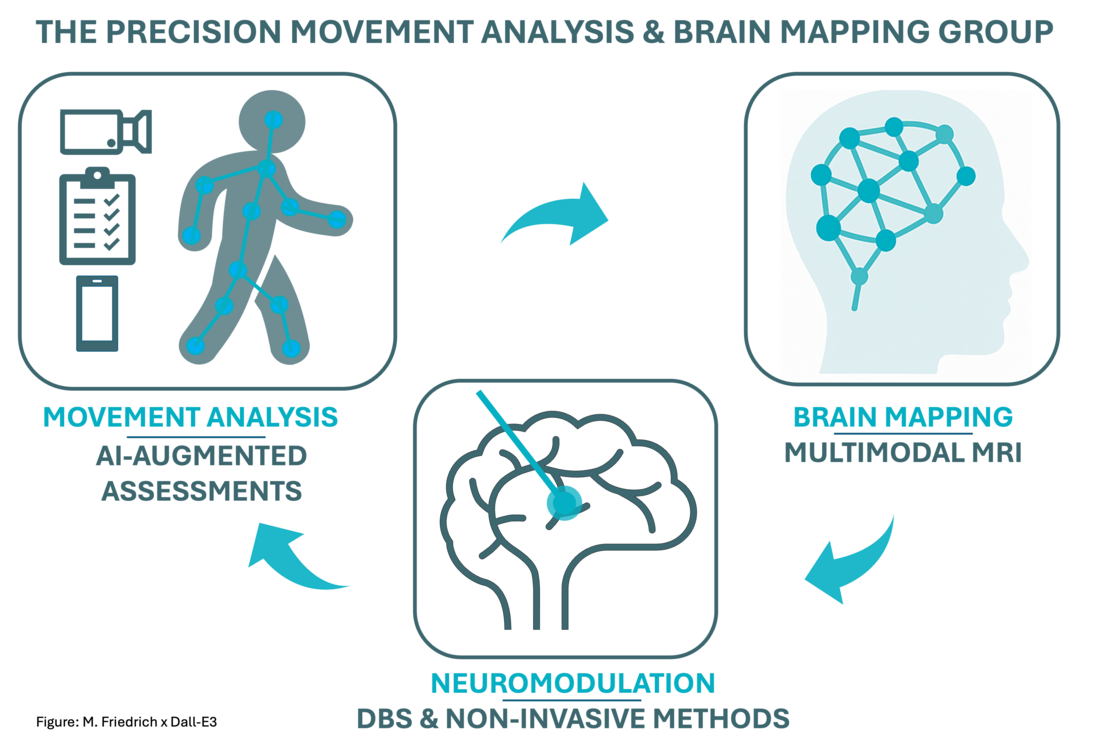
Research areas and methods
- Video-based movement analysis (video-oculography, computer vision, pose tracking)
- Multimodal neuroimaging (voxel- & connectome-based lesion and deep brain stimulation mapping)
- Brain stimulation (deep brain stimulation, non-invasive vestibular stimulation)
- Translational Neuroanatomy (mesoscale brain imaging, histological correlation)
- Development and validation of digital biomarkers of neurological disorders
Group members
The complexity of neuroscientific problems requires interdisciplinary collaboration and integration of multiple perspectives. Our group fosters this exchange by bringing together researchers from diverse backgrounds, including medicine, neuroscience, computer science, and biomedical engineering, united by a shared interest in quantitative approaches to brain–behavior relationships.
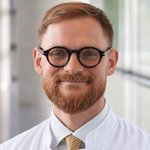
Dr. Maximilian U. Friedrich, MD
Senior Neurologist | Principal Investigator
University Hospital Ulm
Department of Neurology
Oberer Eselsberg 45
89081 Ulm
E-Mail: maximilian.friedrich@uni-ulm.de
- Saloni Jethwa, PhD candidate in computer vision-based movement analysis, University Ulm
- Yury Seliverstov, MD, advanced-clinician scientist in movement disorders, University Hospital Ulm
- Lorenz Peters, MD, attending neurologist & clinical lead neuromodulation, University Hospital Ulm
- Tamina Settele, MD, clinician-scientist, University Hospital Ulm
- Daniel Riedel, MD, clinician-scientist, University Hospital Ulm
- Anna Kellner, MD candidate, Ulm University
- Maren Friedinger, MD candidate (co-supervision with Prof. Brenner), Ulm University
- Danielle Britz, MD dentistry candidate, Uni Wuerzburg (co-supervised)
- Christiana Gödde, MD dentistry candidate, Uni Wuerzburg (co-supervised)
- Timo Schlingmann, BSc computer science, Ulm University (co-supervised)
- Gianluca Amprimo, PhD Computer Engineering, Politecnico Torino, IT
- Renjie Li, PhD Computer Science, University of Tasmania, Hobart, AUS
- Charlie Z. Weige, MD postdoc, Massachusetts General Hospital, Boston
- Diego Rodriguez, MD postdoc, Brigham and Women's Hospital, Boston
Collaborations & Funding
The group is embedded within the Department of Neurology, University Hospital Ulm, with a dual affiliation in the Neurovascular Division (Lead: Prof. Dr. K. G. Häusler) and the Neurodegeneration and Movement Disorders Division (Lead: Prof. Dr. J. Weishaupt). Collaborative partners across Ulm’s academic campuses include the Institutes of Computer Science (Prof. Ropinski), Biomedical Engineering (Prof. Karlen), and Biomechatronics (Prof. Munz, THU).
National and international partners include the Brigham and Women’s Hospital / Harvard Medical School (Boston, USA), the University of Tasmania (Hobart, Australia), the University of Leeds (UK), Politecnico di Torino (Italy), CNRS Marseille, LMU Munich, the University of Cologne (Germany) as well as partners in China (Shanghai, Beijing) and Argentinia (CONICET Buenos Aires).
Our work is generously supported by the Jung Stiftung für Wissenschaft und Forschung (Career Advancement Prize), the Manfred und Ursula Müller-Stiftung (NeuroTech Innovation Prize), and the German Research Council’s (DFG) Emmy Noether Program.
We welcome students, clinicians and scientists with diverse academic backgrounds (medicine, neuroscience, biomedical engineering, computer science and related disciplines). If you’d like to work at the exciting interface of movement analysis, AI and brain mapping, reach out to Dr. Maximilian U. Friedrich at maximilian.friedrich@uni-ulm.de. Please include a CV and a 1-page research statement outlining your interests, skills, and motivation to work with us in this field.
Contact
Dr. Maximilian U. Friedrich, MD
Senior Neurologist | Principal Investigator
University Hospital Ulm
Department of Neurology
Oberer Eselsberg 45
89081 Ulm